
Medically Reviewed: 2 October 2026 • Last Updated: 2 October 2026 • 8 minute read
How to recognise scrub typhus, why it is mistaken for dengue, and why early antibiotics matter.
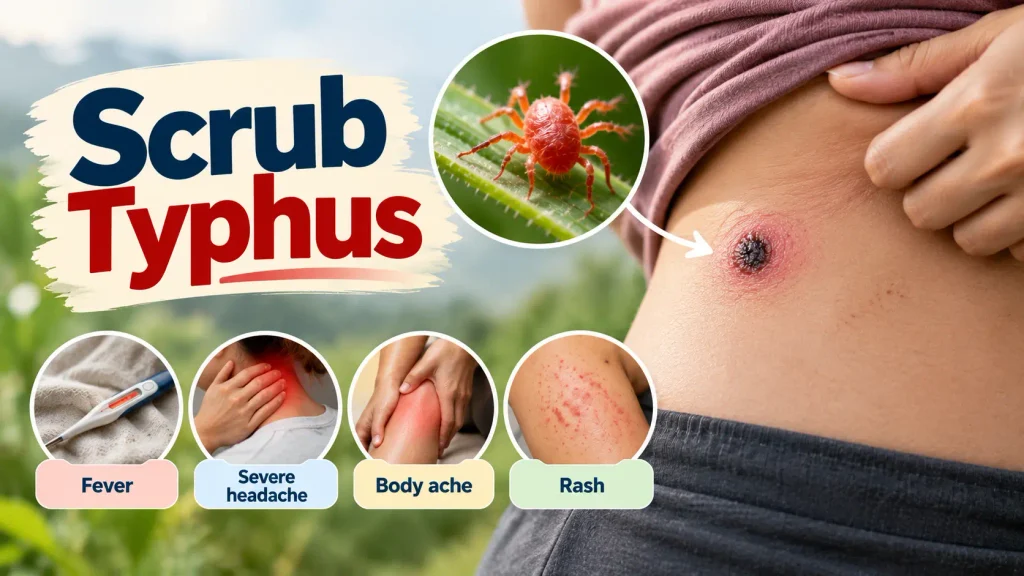
Scrub typhus symptoms begin 6 to 21 days after the bite of an infected mite: sudden fever with chills, severe headache, body ache and tiredness. Because this looks like dengue or any viral fever, the infection is often missed in its first week. The clue that separates it is a dark, painless scab at the bite site called an eschar, found in roughly 1 in 4 Indian patients.
Scrub typhus is a bacterial infection, and it responds well to the antibiotic doxycycline, with fever often improving within 48 to 72 hours. Left untreated, it can damage the lungs, brain, liver and kidneys. In many parts of India, cases increase during and after the monsoon, though the timing varies by region. This guide covers the signs, how it differs from dengue, the tests, the treatment and when to get urgent help.
Quick Answer
- Early signs: Sudden fever, chills, severe headache, body ache, red eyes.
- Important clue: A dark scab (eschar) at the bite site, often under clothing, can strongly suggest scrub typhus.
- Treatment: The antibiotic doxycycline. Fever often improves within 48 to 72 hours.
- Danger signs: Breathlessness, confusion, yellow eyes, very little urine.
What Is Scrub Typhus?
Scrub typhus is caused by a bacterium called Orientia tsutsugamushi. It spreads through the bite of larval mites, known as chiggers, that live in grass, bushes and farmland. The mites are very small and difficult to notice, and the bite is usually painless, so many people do not notice it.
It is not spread from person to person. Farmers, people who work or walk in long grass, and children who play outdoors are most exposed. A 2025 systematic review identified 47,650 reported scrub typhus cases in India across studies published from 2003 to 2023, with outbreaks in Himachal Pradesh, Uttarakhand, Rajasthan, Tamil Nadu, Odisha and other states. In one Odisha study of children with prolonged fever during the rainy months, scrub typhus accounted for 48.7% of cases.
Scrub Typhus Symptoms: 7 Signs to Watch
- Sudden high fever with chills, usually with headache, body aches and marked tiredness.
- Severe headache.
- Body and muscle aches with marked tiredness.
- An eschar: a painless black scab or dark ulcer with a red rim, where the mite bit.
- Swollen, tender lymph nodes, especially near the eschar or in the neck, armpit or groin.
- A rash, usually flat, pink spots that may begin on the trunk and spread to the limbs, seen in only some patients.
- Red eyes, cough and stomach upset, which make it easy to confuse with other fevers.
The Eschar: Why It Matters and Where to Look
The eschar is a highly characteristic clue that can strongly suggest scrub typhus. It looks like a cigarette burn or a dark scab with a red ring, and it does not hurt or itch, which is why it goes unnoticed. In an analysis of 34,002 Indian patients, an eschar was found in about 28.5% overall, and far less often in some states, such as Rajasthan, Haryana and Punjab, where it was seen in 12% or fewer.
Where the Eschar Hides: Body Sites in Indian Patients
Share of eschars found at each site, pooled from 107 Indian studies
Source: Gupta N, et al. Systematic review and meta-analysis of 34,002 scrub typhus cases in India, Infezioni in Medicina, 2024. Overall, an eschar was found in about 28.5% of patients.
Because most eschars sit on the trunk, in the groin or in the armpit, they are usually hidden by clothing. Anyone with an unexplained fever after the monsoon should check the whole body, paying particular attention to these areas, or ask a doctor to.
Scrub Typhus vs Dengue
Early scrub typhus symptoms can overlap with dengue, typhoid and other infections that cause fever in India. Dengue is the most common mix-up in the same season. These clues help doctors tell the two apart, though tests are needed to confirm.
Platelet count alone cannot reliably distinguish these infections, and they can occur together, so doctors often test for more than one.
A falling platelet count does not automatically mean dengue. Scrub typhus can lower platelets too. Our guide to platelet count in dengue explains the numbers, and our dengue cases in India update covers the current season.
Red Flags: When Scrub Typhus Becomes Dangerous
Early treatment greatly reduces the risk of serious complications. Delayed treatment can allow the infection, which inflames blood vessels throughout the body, to affect the lungs, brain, liver or kidneys. A 2025 Indian review reported a case fatality rate of about 5% among the reported cases it analysed. Severe complications are more likely when treatment is delayed.
Get Urgent Care
Breathlessness or fast breathing (lung involvement). Confusion, drowsiness, fits or a very stiff neck (brain involvement). Yellow eyes or skin (liver involvement). Very little urine (kidney involvement). Bleeding from the gums or nose, or black stools.
How Scrub Typhus Progresses
Sources: CDC and MSD Manual. Timings vary between people.
How Doctors Test for Scrub Typhus
The main test is an IgM ELISA blood test, which detects IgM antibodies associated with recent scrub typhus infection. It is often negative in the first few days and becomes positive from about the end of the first week, so a negative early test does not rule the infection out. PCR can detect the infection earlier and may be performed on whole blood or eschar material. The older Weil-Felix test is cheap but misses many cases.
Doctors also check a complete blood count, liver tests, kidney function and, in the same season, a dengue test, and sometimes an H1N1 test if there are flu-like symptoms. When scrub typhus is strongly suspected, doctors may start treatment before test results return, because waiting costs time.
Scrub Typhus Treatment
Scrub typhus is treated with antibiotics, and it responds quickly. Doxycycline is the main treatment under India’s DHR-ICMR guidelines. Azithromycin may be used as an alternative in pregnancy or when doxycycline cannot be used, based on clinical judgement. Fever often starts improving within 48 to 72 hours of effective treatment. If there is no clear improvement, doctors reassess the diagnosis, look for complications and review the treatment. Because scrub typhus can resemble dengue, typhoid, malaria and other infections, antibiotics should be based on clinical assessment and appropriate testing.
Your doctor decides the dose and duration, usually a course of several days. Do not start antibiotics on your own or stop early once the fever drops, and never treat an unexplained fever with over-the-counter antibiotics. Severe cases with lung, brain or kidney involvement are treated in hospital, sometimes with intravenous antibiotics and intensive care.
Paracetamol can be used for fever and pain. Avoid aspirin and NSAIDs such as ibuprofen until dengue has been assessed or ruled out, because they raise bleeding risk if platelets are low. Drink enough fluids unless a doctor has advised otherwise, and eat light, regular meals as appetite returns.
Prevention: Avoiding Mite Bites
- Cover up with long sleeves and trousers in fields, long grass and bushes, especially during and after the rainy season.
- Use a repellent containing DEET or picaridin on exposed skin and clothing edges.
- Avoid sitting or lying on bare ground in grassy areas.
- Wash and change clothes after outdoor work, and check the body for scabs.
- Reduce contact with dense vegetation and scrub around homes, where infected mites may live.
There is no vaccine against scrub typhus.
When to See a Doctor
Fever that persists without a clear cause should be assessed promptly, especially after time in fields or grassy areas during or after the rainy season. Mention any outdoor exposure, and show any scab, even a small one. Other infections cause similar fevers, including H1N1 flu, so testing matters. Go to emergency care for any of the red flags above.
Jaundice can appear when the liver is involved. Our guide to jaundice symptoms explains what yellow eyes or dark urine can mean.
Key Takeaways
- Think of scrub typhus symptoms in any fever after the monsoon, especially after time outdoors.
- Check the trunk, groin and armpits for a painless black scab.
- Know that doxycycline often improves the fever within 48 to 72 hours.
- Treat breathlessness, confusion, yellow eyes or low urine as emergencies.
Frequently Asked Questions
What are the first symptoms of scrub typhus?
Sudden fever with chills, severe headache, body ache and tiredness, usually 6 to 21 days after a mite bite. Swollen lymph nodes and a painless black scab (eschar) may also appear.
What does a scrub typhus eschar look like?
A dark, painless scab or ulcer with a red rim, like a cigarette burn, at the bite site. It is most often on the trunk, groin or armpit and is found in roughly 1 in 4 Indian patients.
How is scrub typhus different from dengue?
Scrub typhus comes from a mite bite, may cause an eschar and swollen glands, and is treated with doxycycline. Dengue comes from a mosquito and has no specific drug. Low platelets can occur in both, so tests are needed to tell them apart.
How long does scrub typhus fever last?
Without treatment, fever can last two weeks or longer and complications may develop. With effective antibiotic treatment, fever often starts improving within 48 to 72 hours.
Which tests are used to diagnose scrub typhus?
IgM ELISA is commonly used in India and often turns positive from the end of the first week. PCR can detect the infection earlier, from blood or eschar material. Doctors interpret results together with symptoms and exposure history.
What is the treatment for scrub typhus?
Antibiotics, usually doxycycline. Azithromycin is the alternative in pregnancy and for some patients who cannot take doxycycline. Your doctor decides the dose and duration.
Is scrub typhus dangerous?
It can be if treatment is delayed. It can affect the lungs, brain, liver and kidneys. A 2025 Indian review reported that about 5% of the reported cases it analysed were fatal. Severe complications are more likely when treatment is delayed.
Can scrub typhus be prevented?
Partly. Cover up in grassy areas, use repellent, avoid sitting on bare ground, and change clothes after outdoor work. There is no vaccine.
References
- Centers for Disease Control and Prevention. About scrub typhus.
- MSD Manual Consumer Version. Scrub typhus.
- Gupta N, et al. Frequency and distribution of eschar in patients with scrub typhus in India: systematic review and meta-analysis. Infezioni in Medicina, 2024.
- Indian Pediatrics. Profile of pediatric scrub typhus in Odisha, India, 2019.
- Journal of Clinical and Diagnostic Research. Serologically confirmed scrub typhus among children in a sub-Himalayan district of India, 2023.
- Journal of Family Medicine and Primary Care. Scrub typhus: clinical profile and diagnostic issues in the sub-Himalayan region of India, 2019.
- Cleveland Clinic. Typhus: types, symptoms and treatment.
- Medscape. Scrub typhus: overview, diagnosis and treatment.
Written By
Iraphan Khan, BSN, RN, D.Pharm, Public Health Researcher. Iraphan writes evidence-based patient guides that turn medical reports and research into plain language.
Medically Reviewed By
Dr Praveen Verma, MBBS, MD Pathology
Dr Himanshu Morya, MBBS, Medical Educator
Published and reviewed: 2 October 2026. Next scheduled review: October 2027.
Disclaimer: This article is for general education and does not replace advice from your own doctor, nurse or pharmacist. Fever that persists without a clear cause, especially with outdoor exposure, severe symptoms or warning signs, should be assessed by a doctor. Do not start or stop antibiotics on your own. If you have breathlessness, confusion, yellow eyes or very little urine with fever, seek urgent care.